
Your Pet, Your Decisions — Navigating End-of-Life Care When You and Your Vet See Things Differently
Jun 29, 2026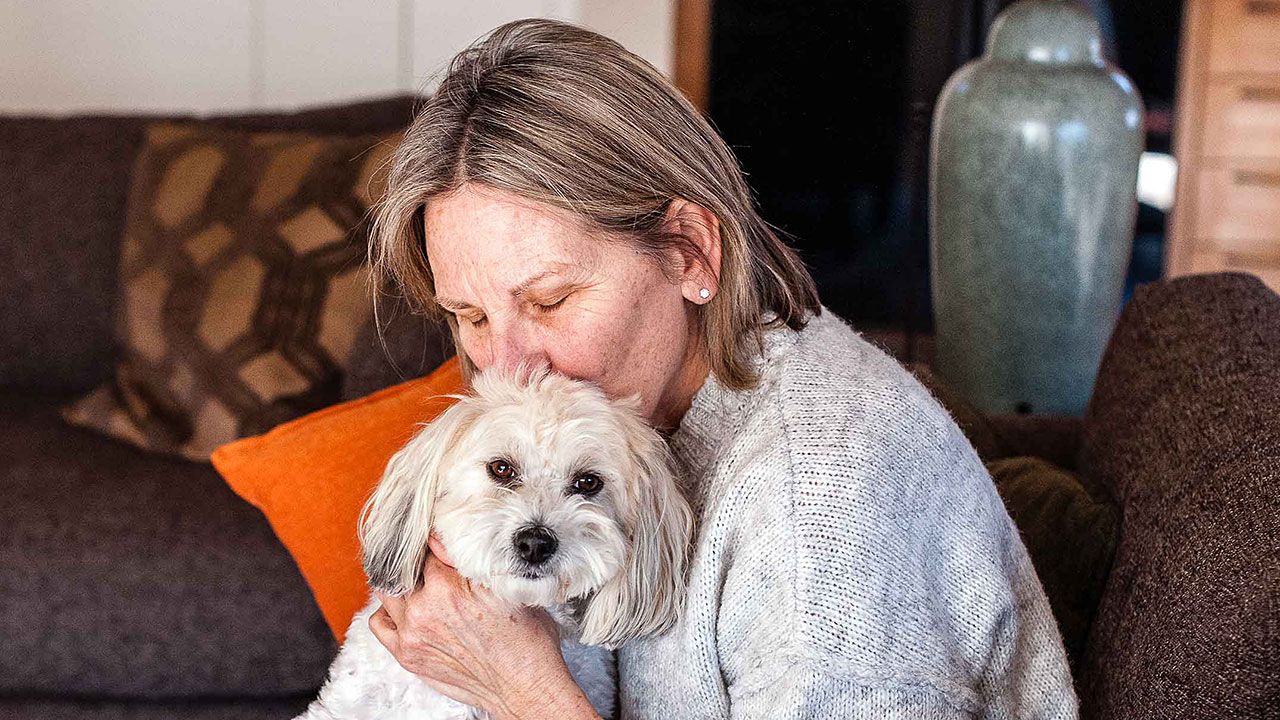
Your Pet, Your Decisions —
Navigating End-of-Life Care When You and Your Vet See Things Differently
By Michelle Nichols, MS, HonCAHP, CGRS | Animal Hospice Coach, Educator, Mentor, and Certified Grief Recovery Specialist, AHELP Founder
There is a particular kind of loneliness that comes with caring for a seriously ill animal. It settles in somewhere between the diagnosis and the decline — in the midnight hours when you are watching your pet breathe and wondering if you are doing enough, deciding correctly, waiting too long, or moving too fast. It is the loneliness of bearing a decision that cannot be undone, often without a roadmap, and sometimes without anyone to call.
What most families don't know — and what this article is about — is that being unprepared for this journey has real consequences — not just emotional ones. Families navigating a pet's serious illness often find themselves:
- Searching online at midnight when something changes and they don't know if it's serious
- Unsure what to report to their veterinary team, or whether what they're seeing even warrants a call
- Making decisions in panic because no one told them what to watch for
- Wrestling with difficult financial decisions — wondering how much to spend, whether they can sustain the cost of ongoing treatment, and feeling guilty regardless of what they choose
- Quietly withdrawing from work, friends, and the activities that used to restore them — while the people around them may not fully understand the weight of what they're carrying
- Carrying caregiver fatigue that builds slowly and without warning across weeks or months of around-the-clock care
- Living with guilt afterward, wondering if they waited too long or moved too fast — when what they actually lacked wasn't certainty, but support
None of this is inevitable. And none of it is your fault.
Understanding what you are actually entitled to as a caregiver can change how you move through this season with your pet. It can help you make decisions you can live with — not because they were perfect, but because they were yours, made with care, with information, and with support.
The Decisions Nobody Prepares You For
End-of-life care for animals is not a single decision. It is a series of them, arriving in no particular order, often without warning, and almost always in the presence of grief:
- When to stop pursuing aggressive treatment and shift to comfort care
- Whether a procedure is likely to restore comfort, buy meaningful time, or simply add burden without clear benefit — and how to tell the difference
- When hospice is the right framework for your pet and your family
- How to weigh your values, beliefs, financial realities, and goals — and find options that are truly aligned with them, rather than defaulting to what feels expected
- What kind of death is right for your pet and for your family — whether that means a peaceful home euthanasia, a hospice-supported natural death, or something in between
That last question deserves more than a default answer, and it deserves a care team willing to help you think it through.
Each of these decisions belongs to you. Not to your veterinarian, not to a quality of life scale, and not to a well-meaning friend with an opinion. To you, grounded in your knowledge of your animal, your values, and your honest assessment of what your pet's life looks and feels like day to day.
Many families carry guilt long after these decisions are made, replaying choices as though there were a clear right answer they missed. Most of the time, there wasn't. There was the decision they made with everything they knew and felt at the time — and that decision deserves respect, not interrogation. What changes the experience of making these decisions is not the elimination of uncertainty, but the presence of support.
Two families illustrate what that difference looks and feels like.
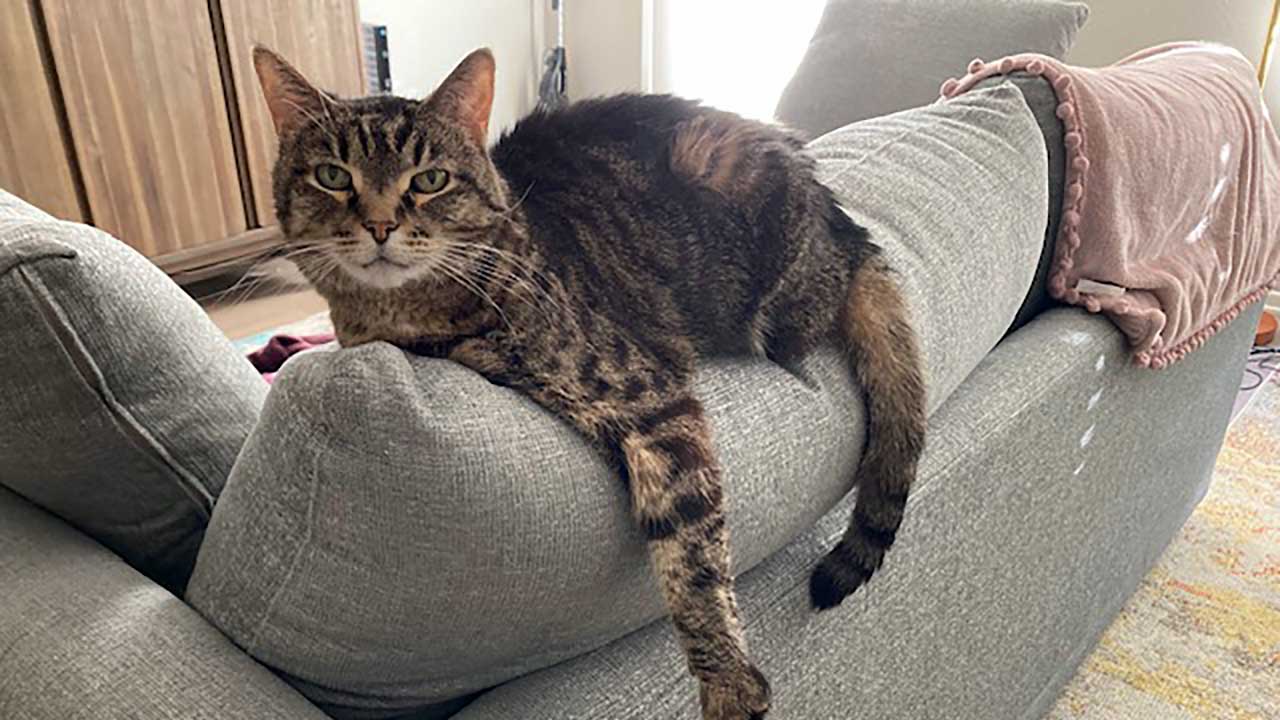
Photo caption: Peaches, Allison's cat, relaxing on the back of the couch cushions looking right at the camera. Photo courtesy of Allison Hudock.
When You Choose Pet Hospice Without a Roadmap: Allison and Peaches
Allison Hudock's tabby cat, Peaches, came to her in 2021 as a 10-year-old foster. In June 2023, diagnostics confirmed advanced small-cell gastrointestinal lymphoma — a form of intestinal cancer — and Allison was faced with a decision no pet parent is ever truly ready for. After consulting with an oncologist, Allison made a clear and considered decision: comfort and quality of life were her priorities. She chose hospice care at home.
What she didn't have — what no one gave her — was any guidance on what that actually meant in practice.
"Despite my reliance on veterinary professionals," Allison later wrote, "no one guided me through the process of what hospice care for cats looks like day to day." The caregiving journey that followed was isolating in ways she hadn't anticipated, fueling a level of burnout she had never experienced before. On November 6, 2023, she said goodbye to Peaches through euthanasia — and in the weeks that followed, began to see clearly what had been missing: not the veterinary procedure at the end, which was handled with care, but the months before it.
Allison's experience set her on a path to do better for other families. While pursuing her Certified Animal Hospice Practitioner credential through the Animal Hospice Group — a program I co-founded and teach in — she found me and the AHELP Project on LinkedIn.
When we connected, Allison shared with me the story of how Peaches' journey had led her to seek out this education. I later encouraged her to write about it — because stories like hers have the power to create real change. In reflecting on her journey, she turned to Maya Angelou's words as her mantra: "Do the best you can until you know better. Then, when you know better, do better." Looking back, Allison has shared that she wonders whether she might have had more time with Peaches if she had known how to manage her comfort more effectively — and that question drives her work today.
Her story is not unusual. It is, in fact, the norm — and that is precisely the problem.
Quality of Life: A Warning System, Not a Verdict
Before we talk about the euthanasia decision specifically, it's worth pausing on quality of life assessment, because it is one of the most misunderstood tools available to families navigating a pet's decline.
Dr. Amir Shanan, Partners to the Bridge Medical Director and founder of the International Association for Animal Hospice and Palliative Care, centers quality-of-life assessment on two essential capacities: whether your animal can still connect with their family and whether they can still engage with their surroundings—showing curiosity, presence, and responsiveness.
Animals are remarkably resilient, and most continue to find meaning in their lives as long as those two capacities remain. When a pet can no longer consistently show connection or engagement, that shift signals that the time for end-of-life decision-making has genuinely arrived — but it doesn't tell you exactly when to act. Changes in quality of life are warning signs, not verdicts. They prompt you to engage more deeply in the process, not to hand the decision over to a scale.
Dr. Shanan and I have been developing AHELP's own Quality of Life Assessment System, due out later this year. If you'd like to be among the first to receive it, you can sign up by clicking here.
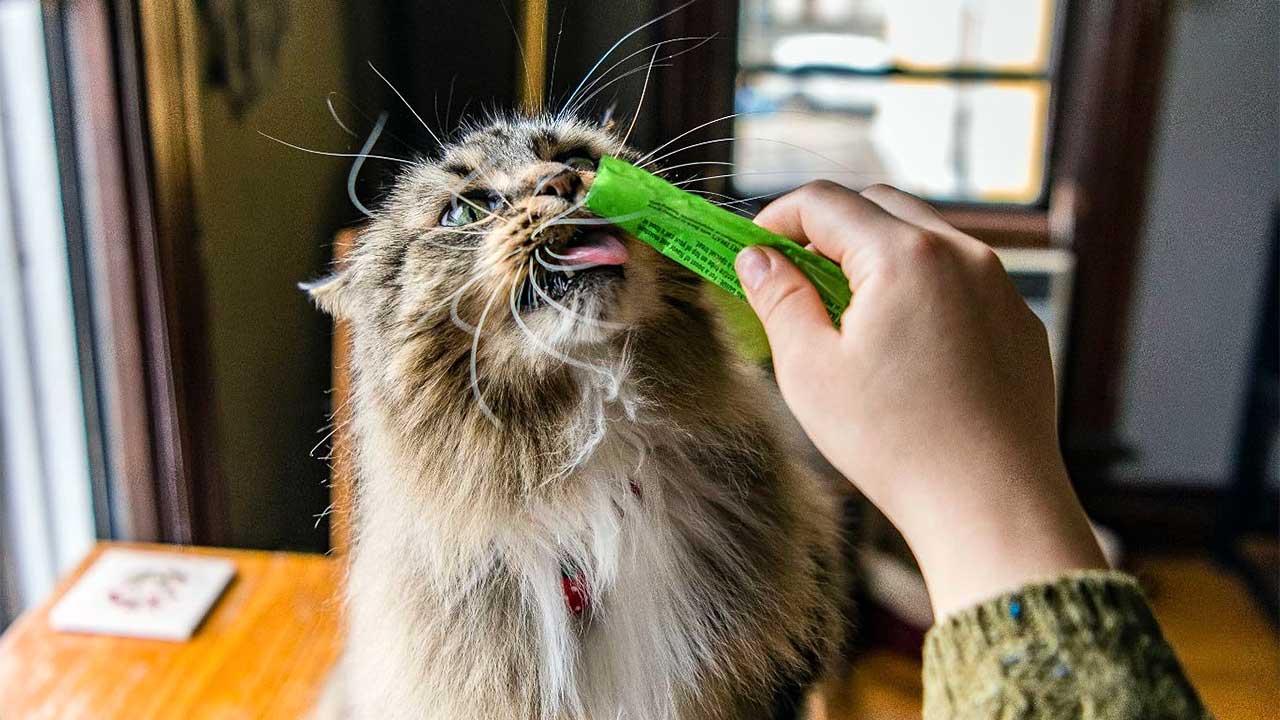
Photo caption: Senior cat being fed by pet caregiver. Photo credit: HeARTS Speak.
When the Decision Can't Wait: Mei and Sarang
The following story is based on a real case. Identifying details, including names, have been changed to protect the family's privacy. The AHELP team members, veterinary professionals, and animal communicators are identified by their real names.
When Mei's Maine Coon, Sarang, was diagnosed with advanced kidney disease, she had already lived through pet loss before — and that history made the uncertainty of this journey feel heavier, not lighter. She knew the road had a horizon. What she didn't know was how to read the terrain between here and there, or who to call when the questions outpaced her capacity to carry them alone.
Through AHELP's Partners to the Bridge Animal Hospice Coaching, Mei connected with me, and I walked alongside her as Sarang's condition progressed — helping her document what she was observing, interpret what the symptoms might mean, and stay connected to the care decisions ahead.
Mei had already been working with animal communicator Polly Klein, someone she knew and trusted. After an especially intense session, Mei shared the recording with me — she had been sobbing throughout — and together we sat with what Polly had relayed and what Sarang seemed to be asking for. Processing that session was its own kind of work: sorting through the emotion, reflecting on what it meant, and helping Mei hear what she most needed to hear from it.
As we worked through what the session had revealed, I also brought in Dr. Amir Shanan, who reviewed Sarang's condition with Mei through a quality-of-life lens. Dr. Shanan helped her see that Sarang's declining ability to connect and engage — the two capacities at the center of his QOL framework — was the clearest signal that his body was reaching its limit. That perspective gave Mei something concrete to hold onto: not a number on a scale, but an honest picture of where Sarang was and what he was still able to experience. It helped shift her focus from what more could be done medically to what would protect the quality of the time he had left.
This kind of support is at the heart of the Path of Least Regrets — the larger framework we use in Partners to the Bridge Animal Hospice Coaching. POLR isn't a single tool or a single day. It is a process that helps families find their True North: clarifying their values, goals, and beliefs, and using them to build an advance directive — an end-of-life plan — for their pet. As part of that process, families identify Decision Landmarks in advance: the specific signs or changes that will prompt them to revisit their plan, rather than waiting until a crisis forces the decision. The goal is for families to not start from scratch when the hardest moments arrive. They are returning to something they have already thought through, with support, from a place of love rather than panic.
With that foundation in place, Mei was able to spend a day simply being present with Sarang — offering food without pressure, sitting close, speaking softly, letting him set the pace. She later described that day as one of the most peaceful of their entire journey together — a shift from doing to being that brought them both relief.
When Sarang's condition made clear that further intervention was unlikely to restore his comfort, I connected Mei with Certifed Animal Hospice Veterinarian Dr. Sara Hopkins,DVM, CHPV, of greater Seattle’s Compassion 4 Paws. Dr. Hopkins visited Mei's home, conducted a full assessment, and was direct: Sarang's illness had progressed significantly, and additional treatments were unlikely to help. She also told Mei something equally important — that the care she had provided throughout his illness had been extraordinary and had mattered deeply.
Mei chose to help Sarang go peacefully that same day, at home, in his favorite spot and with a friend there to support her. The procedure was gentle and unhurried, and Dr. Hopkins remained kind and patient throughout. Two days later, I held a post-loss consultation with Mei — creating space to process the decision, understand the medical context, and begin moving through grief with support rather than alone. The knowledge she had gained through this journey, painful as it was, left her better equipped and more confident for whatever lay ahead with the animals she loves.
Why These Conversations Are Hard for Everyone
➡️ There's another reason these conversations can feel so hard, and it's not about you.
Veterinarians went into this profession to heal and cure animals. Guiding a family through grief, denial, and end-of-life decisions is not something most of them were ever trained to do — and yet it's increasingly part of the job. So if a conversation with your vet has ever felt stiff, rushed, or strangely indirect, it may have less to do with how much they care and more to do with how hard it still is, for anyone, to say the hard thing out loud. I sometimes call this the avoidance of the "D" word — death — and it happens on both sides of the table. Families are often reluctant to face where a condition is truly heading, and vets are often unsure how to lead them there. When no one names it, everyone — including the pet — ends up waiting longer than they need to.
Recognizing this gap, the profession has put forward animal hospice and palliative care as part of the answer — and the veterinary practice guidelines supporting it couldn't be clearer.
When AAHA updated and published its End-of-Life Care Standards in 2024, the American Veterinary Medical Association (AVMA) affirmed them — reinforcing that this collaborative, interdisciplinary approach, first called for back in 2016, remains the standard the profession holds itself to. I helped edit those original 2016 Guidelines during my time on the IAAHPC board.
These are not wish-list documents — they are the profession's own statement of what families deserve. You can rest assured that you deserve end-of-life care for your pet and the caregiver support described in these documents. Further, the difference between that vision and what most families experience isn't a sign that vets don't care; it is a sign that the system hasn't yet caught up with what its own best thinkers have been saying for nearly a decade. Animal hospice and palliative care is the bridge the profession has built — and most families don't know it exists. To fill the structural gap in veterinary medicine recommended by these Guidelines, we at AHELP Project have built our Partners to the Bridge Animal Hospice Coaching.
What I've observed is that most families don't know what to do with that knowledge once they have it. So let me make it concrete: ask your own veterinary team directly whether they're familiar with the AAHA/IAAHPC interdisciplinary model. (See Point #5, below, for the specific kinds of support available and how to find them.) In my experience, most veterinarians welcome that question — it tells them you understand what they are already trying to build toward.
Things Every Family Should Know About Animal Hospice and Palliative Care
Allison poured everything she had into caring for Peaches — and did it entirely alone. Without the tools to manage Peaches' comfort or anyone to help her see other options, she made the best decision she could with what she had. Mei had that support, and it changed everything — not just how Sarang's final days unfolded, but how she was able to carry the loss afterward. Two families, the same love, one crucial difference.
Here is what you, as a caregiver, are entitled to know and to claim.
1. Start the Conversation Before You Need To
If your pet has a terminal diagnosis, a chronic illness, or is simply aging noticeably, ask your vet directly about what decline looks like for their condition, what to watch for, and what options exist beyond the endpoint. Most veterinarians welcome this question, and many wish you would ask it sooner. To make that conversation easier, we've put together a free guide — 40 Questions to Ask Your Vet About the Diagnosis and End of Life — that you can download for free when you sign up HERE for our mailing list. Bring it to your next appointment and let it do the heavy lifting of starting the conversation.
2. It Is Never Too Soon to Ask About Hospice and Palliative Care
Many families assume that hospice and palliative care means giving up, or that it comes with a higher price tag. Neither is true. Animal hospice and palliative care is a philosophy of care — a mindset shift toward comfort, quality of life, and being proactive rather than reactive. It is not a dramatic departure from what most families already choose for their pets. It is simply a more intentional version of it, and it is never too early to ask your veterinary team whether this framework might be right for you. We can be of most support when you inquire about it and become involved with a practitioner sooner (see last paragraph in this article for details).
3. Track and Report Quality of Life Regularly
Use whatever quality of life tools your veterinary team recommends, and report what you observe consistently — not just at appointments, but between them. Tracking can feel burdensome, especially during periods of relative stability, and that is understandable. If no formal scale has been recommended, something as simple as noting "good," "okay," and "bad" days on a calendar can reveal meaningful trends over time and give your care team something concrete to work with. Dr. Shanan and I are also developing AHELP's own Quality of Life Assessment System, due later this year — sign up by clicking here to be among the first to receive it.
4. Trust in Yourself
Many families feel intimidated in a veterinary setting — uncertain whether their observations matter, worried they will be pressured into a decision they aren't ready for, or even avoiding the vet altogether out of fear of what they might be told. If any of that sounds familiar, you are not alone — and you are not powerless.
You are your pet's voice and greatest advocate. No one in that room knows your animal the way you do — what a good day looks like for them, what has changed, and what matters. That knowledge belongs in every conversation with your care team, and a good team will treat it as something they genuinely need to hear. If you feel unheard, say so. If something doesn't sit right, ask again. You have both the right and the responsibility to be part of these decisions.
5. You Deserve Caregiver Support — and It Comes in Many Forms
The 2024 AAHA End-of-Life Care Standards and the AVMA/AAFP joint guidelines are explicit: families navigating a pet's end of life deserve interdisciplinary support — meaning a team of professionals from different backgrounds, each bringing something different to your family's care — not just medical care for their animal, but emotional, practical, and spiritual support for themselves. That support exists at multiple levels and price points, and spending beyond your means is not a prerequisite for loving your pet well. Please don't self-select out because you assume you can't access it.
Certified Palliative Care Veterinarians provide medical oversight and clinical guidance through the full arc of decline. Veterinary nurses certified in hospice and palliative care offer hands-on clinical support. Certified Animal Hospice Practitioners are trained to provide caregiver coaching, education, and support through the journey. Animal Hospice Chaplains — not tied to any religion, and trained through an extensive certification — are uniquely qualified to hold the deeper spiritual questions and emotional weight that grief and loss bring up for so many families. Pet Death Doulas offer companionship and presence throughout the dying process. And beyond credentialed professionals, the trusted friends in your life may be more capable of showing up for you than they realize — sometimes people simply need to be told what you need and given permission to help.
Whatever your circumstances, there is very likely someone qualified to walk alongside you. You do not have to do this alone.
A Final Word
Euthanasia is not end-of-life care. It is the last five minutes of it. The decisions that lead to that moment — when to stop pursuing a cure, when to shift to comfort, when to enroll in hospice, when to finally let go — deserve the same quality of attention, guidance, and compassion that veterinary medicine has invested in the moment itself.
Begin conversations with your veterinary team earlier. Identify and consider clearer pathways to palliative care. Equip yourself in advance.
For instance, families who know what pain looks like in an animal that hides it — before they find themselves at midnight with a Google search and a breaking heart. That is what Allison deserved when she chose animal hospice for Peaches. That is what Mei found when she reached out for support for Sarang. And it is what every family navigating this journey deserves.
If you are in this season with your pet right now, know that the fact that you are thinking carefully about this, trying to understand both sides of the table and do right by the animal you love, already tells you something about the kind of pet guardian you are. You are not alone in this — even when it feels that way. And when the time comes to make the call you cannot take back, you will make it with everything you have.
That is the path of least regrets. And it is enough.
Michelle 🐾♥️👣🌈
( Blog post banner: Michelle Nichols blog post, Your Pet, Your Decisions — Navigating End-of-Life Care When You and Your Vet See Things Differently, photo of pet caregiver hugging her senior dog, photo credit: HeARTS Speak )
|
About the Author: Michelle NicholsAs an Animal Hospice Coach and Educator—a Pet Hospice Partner—I have the privilege of supporting families through one of life’s most sacred and challenging passages: accompanying a beloved dog or cat in their final chapter. My goal is to offer not only practical guidance but also emotional support and a deeper way to relate to this time—not just as an ending, but as a meaningful, even healing experience. With 30 years of combined experience in human and pet-related grief counseling, I continually refine my skills to serve pet parents best and to help prepare the next generation of pet hospice leaders through education and mentorship. My virtual door is always open. Reach me at [email protected]. |
Join Our Newsletter List!
You’ll receive the latest blog posts, useful tools, and plenty of inspiration. As a special gift, you'll receive a FREE Handout Combo download of Animal Quality of Life Indicators to Report to Your Veterinarian AND 40+ Questions to Ask Your Veterinary Team—both a valuable resource!

