

When the Veterinary Bill Hits as Hard as the Diagnosis
By Michelle Nichols, MS, HonCAHP, CGRS | Animal Hospice Coach, Educator, Mentor, and Certified Grief Recovery Specialist, AHELP Founder
Tax Day is a good reminder that financial planning for your pet isn't pessimistic — it's one of the most loving things you can do.
Today, millions of Americans are filing their taxes, reviewing their finances, and thinking — maybe for the first time in a while — about where their money goes and where it needs to go. It's a moment of clarity that doesn't come around often.
We want to borrow that energy for something you might not have on your tax form, but that deserves a spot in your financial planning: your pet's care.
Not because something is wrong right now. But because it might be, someday. And because the families who navigate that moment with the least amount of regret are the ones who thought about it before they were in the middle of it.
Today, we're introducing a new page on our website — a curated guide to veterinary financial assistance organizations for pet families who need help covering the cost of care. And this month, we're also releasing something we've been working on for our coaching families and AHELP community members: a new and improved Pet Care Budget Planner, exclusively available to you. More on that below.
Source: Synchrony, Financial Solutions for the Increasing Costs of Pet Care, 2023.
Nearly half. And that number climbs when the diagnosis is serious — cancer, organ failure, neurological conditions, or the slow, complicated journey of an aging pet approaching the end of life.
End-of-life pet care costs are among the least-discussed — and least-covered — expenses in pet ownership. The financial weight of serious illness doesn't fall equally. It often falls hardest on the people who love their animals the most — people who will do anything for their pet, but who genuinely don't have the resources to do everything a specialist might recommend.
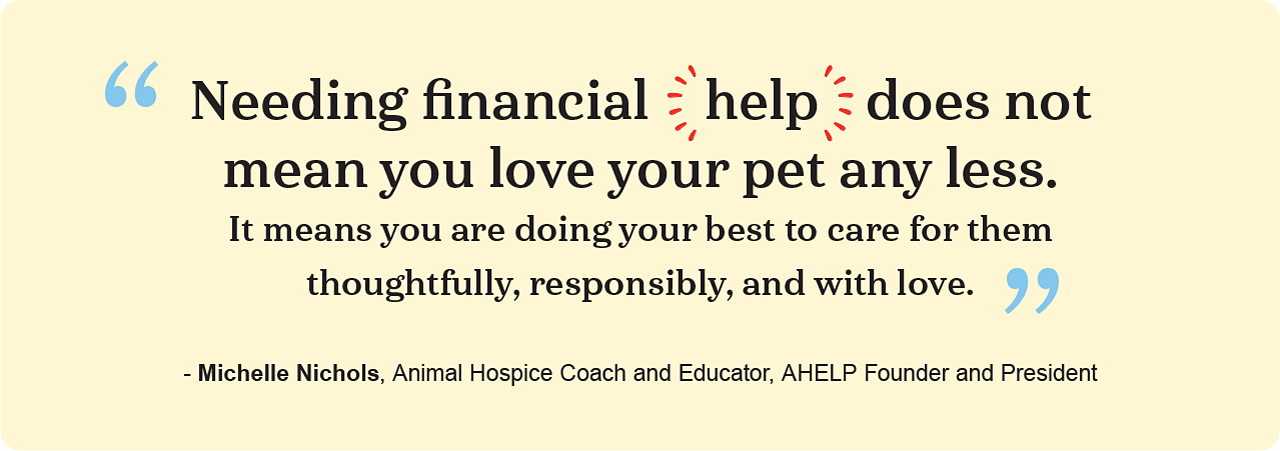
Quote caption: "Needing financial help does not mean you love your pet any less. It means you are doing your best to care for them thoughtfully, responsibly, and with love." ~ Michelle Nichols, AHELP Project
A New Resource for Families Navigating the Cost of Care
We've built a webpage — organized, practical, and honest — that lists veterinary financial assistance organizations by type of support: emergency care, chronic or serious illness, cancer-specific funds, mobility and equipment needs, and programs for seniors, low-income families, and people experiencing housing instability.
Each listing includes what the organization covers, what it doesn't, and how to apply. Because when you're in the middle of a crisis, you shouldn't have to sort through vague websites to figure out if you even qualify.
We currently have resources organized for national, California, and Washington State residents, available now on our website.
The page also includes a step-by-step application guide — what documentation you'll need, why applying to more than one organization at a time matters, and what to do while you wait for a response.
Three Ways to Build a Financial Safety Net — Before You Need One
Pet care financial planning doesn't require a financial advisor or a large income. It requires intention — and a little information. If you've ever wondered how to pay for vet bills when a crisis hits, you're not alone — and you're not without options. Here are three approaches, and our honest take on each.
1. A dedicated emergency vet fund
This is our first recommendation, and it's simpler than it sounds. Open a separate savings account — even a basic one — and label it your emergency vet fund. Contribute to it when you can, even in small amounts. When something happens, you have a resource that isn't your rent money or your credit card.
There's something else this account does that a policy can't: it gives you options. When you have savings set aside for your pet, financial stress doesn't have to be the deciding factor in a hard medical moment. You can think more clearly, ask better questions, and make decisions based on what's right for your animal — not just what you can afford at that moment.
If you're able to do only one thing on this list, this is the one we'd suggest.
2. Pet insurance for dogs and cats — as a monthly auto-deduction
Pet insurance for dogs and cats has grown significantly in recent years — and for good reason. If building a dedicated savings account feels like a stretch right now, pet insurance can offer similar protection — and because the premium comes out of your account automatically each month, it builds a financial safety net without requiring a separate savings habit.
Most plans use a reimbursement model: you pay the vet bill, submit the claim, and receive a percentage of the amount paid — typically 70 to 90% — after your deductible. Monthly premiums generally range from $30 to $70 for dogs and $15 to $40 for cats, depending on the plan, your pet's age, and where you live.
But we want to be honest with you about what insurance does and doesn't cover — because the gaps matter, especially for our families.
- Accidents and injuries
- Illnesses (after waiting periods)
- Surgeries and hospitalizations
- Diagnostics and imaging
- Specialist and emergency care
- Some chronic conditions (if not pre-existing)
- Cancer treatment (varies by plan)
- Pre-existing conditions (rarely covered)
- Wellness and preventive care (add-on only)
- Dental disease
- Hereditary conditions (vary widely)
- End-of-life and hospice care
- Grief and caregiver support
The part that insurance doesn't reach
Pet insurance can be a meaningful safety net for veterinary bills. When a policy covers an illness or age-related condition, it may reimburse a meaningful portion of those costs. That's real and worth exploring.
But the support that many families need most during serious illness or end of life — the coaching, the conversations, the help understanding what quality of life looks like, the caregiver support, the guidance through grief — that is not covered by pet insurance. Pet hospice costs, including comfort care, caregiver support, and end-of-life coaching, fall outside the scope of any standard pet insurance policy.
Our care coaching and caregiver support services are no exception. They are not reimbursable through pet insurance — and we want you to know that clearly, before you're in a moment where it matters.
One resource worth checking: if you have an Employee Assistance Plan (EAP) through your employer, a licensed clinical social worker may be covered for human grief and caregiver support. It's an underused benefit that many people don't know to ask about. Call the number on your EAP card and ask specifically about grief support and caregiver counseling.
Understanding pet insurance pre-existing conditions is one of the most important things you can do before you buy. The best time to get pet insurance is when your pet is young and healthy — before any conditions appear in their medical records. Once a condition is documented, it's typically considered pre-existing and excluded from coverage. If your pet is already ill, insurance is unlikely to help with the current situation, but may still offer protection for future, unrelated conditions.
If you're comparing policies, look carefully at annual limits, per-incident caps, reimbursement percentages, and how each policy defines "pre-existing condition." Reputable comparison resources include Forbes Advisor, NerdWallet, and NAPHIA (the North American Pet Health Insurance Association).
3. Financial assistance programs — when the unexpected has already arrived
Sometimes planning didn't happen, or wasn't possible, and you're already in the middle of a crisis. These organizations exist specifically to provide financial help for sick pets and the families who love them — and knowing they exist, and how to access them quickly, is its own kind of preparation. That's what our resource page is for.
A New Budget Planner, Exclusively for Our Community
We know that pet care financial planning is easier with the right tools. This month, we're releasing a new and improved Pet Care Budget Planner — exclusively for our coaching families and AHELP community members.
It's designed to help you think through the real costs of your pet's care at every stage: routine wellness, unexpected illness, serious diagnosis, and end of life. Not to be overwhelming — but to give you a clear picture you can actually work with, one that helps you make decisions from a place of preparedness rather than panic.
If you're a Partners to the Bridge coaching client or an AHELP community member, watch for your exclusive access link.
Join the AHELP Community by signing up for our newsletter! Find the form below ⬇️.
Planning Ahead Is an Act of Love
We say this not to create anxiety — but because we've walked alongside enough families to know: the conversations that happen in advance are almost always easier than the ones that happen in a waiting room at midnight.
Thinking now about what you would do, what resources exist, and what your values are around your pet's care — that's not morbid. That's being prepared. And prepared families make decisions they're less likely to regret.
Tax Day asks you to take a hard look at your finances. We're asking you to extend that same clear-eyed attention to your pet's future — not because something is wrong, but because you love them enough to be ready.
Explore AHELP’s Financial Help and Resources Page, organized by type of support, with a step-by-step application guide.
Get the Pet Care Budget Planner, new later this month — exclusively for our coaching families and AHELP community members.
We're Here for the Whole Journey
Veterinary financial assistance organizations can help with some of what your veterinarian charges. But the full experience of caring for a seriously ill or aging pet — the emotional weight, the hard decisions, the grief that starts before the loss — that takes more than a grant or a reimbursement check.
If you need help thinking through care options, preparing for a difficult conversation with your vet, or simply figuring out where to start, we're here for that. That's what AHELP Project is for.
Reach out anytime. No question is too early, and no family is too far along.

Quote caption: "Planning for the future of your pet isn’t about expecting the worst. It’s about loving them well for every part of the journey. " ~ Michelle Nichols, AHELP Project
( Blog post banner: Start planning early for unexpected veterinary needs or end-of-life pet hospice care, photo of a smiling Millennial woman with black French Bulldog puppy. )
|
About the Author: Michelle NicholsAs an Animal Hospice Coach and Educator—a Pet Hospice Partner—I have the privilege of supporting families through one of life’s most sacred and challenging passages: accompanying a beloved dog or cat in their final chapter. My goal is to offer not only practical guidance but also emotional support and a deeper way to relate to this time—not just as an ending, but as a meaningful, even healing experience. With 30 years of combined experience in human and pet-related grief counseling, I continually refine my skills to serve pet parents best and to help prepare the next generation of pet hospice leaders through education and mentorship. My virtual door is always open. Reach me at [email protected]. |
Join Our Newsletter List!
You’ll receive the latest blog posts, useful tools, and plenty of inspiration. As a special gift, you'll receive a FREE Handout Combo download of Animal Quality of Life Indicators to Report to Your Veterinarian AND 40+ Questions to Ask Your Veterinary Team—both a valuable resource!

