

How to Write a Pet Obituary (With Examples) 🐾
A Legacy-Building Practice for Families Navigating Pet Loss
By Michelle Nichols, MS, HonCAHP, CGRS | Animal Hospice Coach, Educator, Mentor, and Certified Grief Recovery Specialist, AHELP Founder
March has a way of arriving gently, even when winter has been hard.
For many families who lost a beloved companion during the colder months — the quiet weeks when illness often tightens its hold — spring can feel like a tender invitation. An invitation to finally exhale. To look back. To remember.
One of the most meaningful things you can do after the death of a beloved animal companion is to tell their story.
Not because it is required. Not because there are rules. But because love deserves to be remembered.
In human hospice care, storytelling and legacy-making are recognized as powerful tools for grief healing. Families write letters, record memories, and create tributes to honor the life of someone they love.
The same can be true for our animals.
At the AHELP Project — the Animal Hospice, End of Life, and Palliative Care Project — we support families navigating animal hospice and palliative care, helping them focus on pet quality of life, comfort care for pets, and thoughtful decision-making during serious illness. Whether you are exploring pet hospice at home, have recently said goodbye, or are still finding your footing after loss, many caregivers discover that legacy-making helps them begin to process the emotional journey.
Writing a pet obituary can help you:
- Reflect on the life you shared
- Celebrate your pet's personality — the real one, the funny one, the one only your family knew
- Acknowledge the caregiving journey
- Create meaning from loss
- Support healthy grief
In other words, it transforms loss into legacy.
Leader of the Pack 🐕
Many grieving pet parents search for pet obituary examples when they are unsure how to begin. Reading another family's tribute can make the process feel less intimidating — and remind you that there is no wrong way to honor someone you loved.
The obituary below is one of the most moving examples we have ever encountered. It was written by a real family, for their real dog — a joyful, opinionated, deeply beloved shepherd mix we'll call King. King died on a February afternoon. Before he left, his family gave him a voice.
Leader of the Pack
by King
I had to leave you today, but I was able to communicate a few things to Daddy before I left. As outgoing leader of the pack, I feel strongly that Chase, Kasey, Daddy, and Mommy could use a few guidelines that I figured out as Pack Leader.
So here are my 8 simple steps to pack leadership:
- Forget about anything bad that happened yesterday or even ten minutes ago. It is way more fun to wag your tail and be happy every time you see one another. Besides, you can sometimes snag a treat by being extra cute, playful, or just running around the dining room table ten or eleven times at full speed. Honestly, I don't know why that made you all laugh so much, but it made me happy to make you happy. A leader loves to make the pack happy.
- Be happy with what you have. Food is really a great invention, but variety is overrated. I'm not sure how you guys do it with all the myriad of foods and smells that Mommy makes. Seriously, does anyone really need more than those freeze-dried bison treats and an occasional licking of the pan? Mommy, I have to tell you that it was really cool when you let me do that. You would probably have fewer arguments with Daddy or Chase if you let them lick the pan once in a while.
- Love unconditionally. ❤️ This is the key to contentment. It's simple, really — just make sure that everyone in the pack knows that you love them no matter what, and more than anything else, even food. OK, sometimes it was pretty close between you and food, but I always knew that being with you and following you around made the whole pack better somehow. The pack is important, and loving the time you have together is the key to always being happy like me.
- Keep the pack within sight. Remember when we went hiking and I always ran between the first and the last of you on the trail, making sure we all stayed together? It is important as incoming pack leaders that you protect one another from danger, play hard, and stay close.
- Never get tired of simple joys. 🎾 If the doorbell rings, bark loudly — someone is protecting the pack. Jump up on visitors to show them you're glad they came. Bonus tip: remember to smell everyone who comes over, since that is the best way to tell the good ones from the bad ones.
- Don't complain. At the end of the day, who likes a whiner anyway? I found that if you lead the pack well, no matter how hard things are, it should only take a soft little "yip!" to mobilize everyone. When my arthritic knees and hips would not cooperate — even in the middle of the night — someone in the pack would come and help me, with just the littlest "yip" from me. In my last few difficult days, you rose to the occasion and loved me well. I would encourage you to chase the ball in the backyard 15 to 20 times as a reward for a job well done.
- Embrace the moment with gusto. 🌊 Remember how I taught Daddy to throw the floaty-thing into the ocean at Cannon Beach? I could do that forever — even though the salt water I swallowed caused us all considerable trouble in the car, the condo, and multiple other places. The point is: if you're going to have fun, don't hold back. Enjoy everything you do with your pack at full speed.
- Forgive and forget. No matter how many times Daddy barked at me to stop begging or come back inside, don’t worry about it. Honestly, I still don't understand why he didn't grasp how important it is to smell the entire perimeter of the yard — I never let that throw me off for more than 30 seconds. No one in the pack can withstand the BBE Treatment ("Big Brown Eyes") mixed with a little "can we play" and one or two laps around the dining room table. Joy in the pack is invariably restored.
Pretty simple, right?
Since I'm already in Heaven and working guideline #7 like crazy, I may not notice that we're apart until we're back together. Still, I know it will be much harder for you — but just remember, I will never stop loving you or looking forward to smelling you when you get to Heaven with me.
Your Pack Leader (retired), King 🐾
What Makes King's Obituary So Powerful
King's family did something remarkable. They didn't just list memories — they became him. They gave King a voice, a perspective, and a last act of love: teaching the family how to carry on.
Notice what they included:
- Specific, irreplaceable details — the freeze-dried bison treats, the dining room table laps, Cannon Beach, the BBE Treatment
- The hard parts, held gently — arthritic knees, middle-of-the-night "yips," the difficulty of the final days
- Humor that is uniquely theirs — because King was uniquely theirs
- A message that heals — not just a tribute to King, but a gift to the family he left behind
This is what a legacy-building obituary can do.
More Pet Obituary Examples 🐾
Not every family will write from their pet's point of view — and that's perfectly fine. Here are two simpler examples to show the range of what's possible.
If you're low on energy — and grief has a way of doing that — a short tribute like one of these is also a gentle, meaningful way to share your loss on social media. Sometimes a few honest sentences invite more support than you'd expect.
Example: A Simple Life Story
Bella — Loyal Companion
Bella joined our family as a curious Golden Retriever puppy who quickly became the heart of our home. Even when arthritis slowed her steps, she still insisted on joining us outside each morning to watch the birds. She reminded us that joy lives in simple routines and quiet companionship.
Run free, sweet girl. 🌈
Example: A Letter to a Cat 🐈
Dear Oliver,
You arrived on a rainy afternoon and immediately claimed the warmest chair in the house. You supervised every book we read and every laptop we opened. You taught us that affection can be quiet but powerful.
Thank you for choosing us.
A Moment to Remember 🌿
Before continuing, pause for a moment and think about your own companion.
What memory appears first?
Perhaps the way they greeted you at the door… or the sound of their footsteps following you from room to room… or that one irreplaceable thing they did that you will never, ever forget.
Those are the details that belong in an obituary.

Photo caption: King’s family was fortunate that Daddy enjoyed taking pictures of him with them. Photo of a Shepard mix dog resting chin on his pet guardian's lap.
How to Write a Pet Obituary ✍️
Writing a pet obituary doesn't have to be formal or perfect. The goal is simply to tell the story of your pet's life — in your voice, with your memories, in whatever form feels right.
Start with "I remember…"
If you're not sure where to begin, start a list:
- I remember how you followed me everywhere.
- I remember the way your ears perked up at the treat jar.
- I remember how you curled beside me when I was sad.
- I remember the one completely unhinged thing you did that I'll be laughing about for the rest of my life.
These small, specific memories often become the heart of a meaningful tribute.
You can also capture their spirit by writing out their best character traits — what made them them. The qualities that changed you. The things you never want to forget. Those aren't small details; they're the life-changing effects your companion had on you, and they belong at the center of any tribute worth keeping.
Shape your memories into a tribute
Once you have your list, you might include:
- How your pet joined the family
- Their personality — the real one, quirks and all
- Specific memories and adventures you shared
- The hard parts of the caregiving journey, and how you showed up
- What they taught you
Many families navigating pet hospice and palliative care find deep comfort in acknowledging the love and attention they gave during their pet's final weeks. That caregiving — the comfort care for pets that so often goes unrecognized — is part of the story too.
Add photos 📷
A favorite sleeping pose. A joyful adventure. A silly everyday moment. A quiet hospice memory.
Photos tell the story visually and preserve the life you shared in a way words alone cannot.
Share your tribute
Sending a tribute by email or posting it on social media often invites unexpected support — from friends, neighbors, coworkers, and fellow animal lovers who may not have known how to reach out until you gave them a way in.
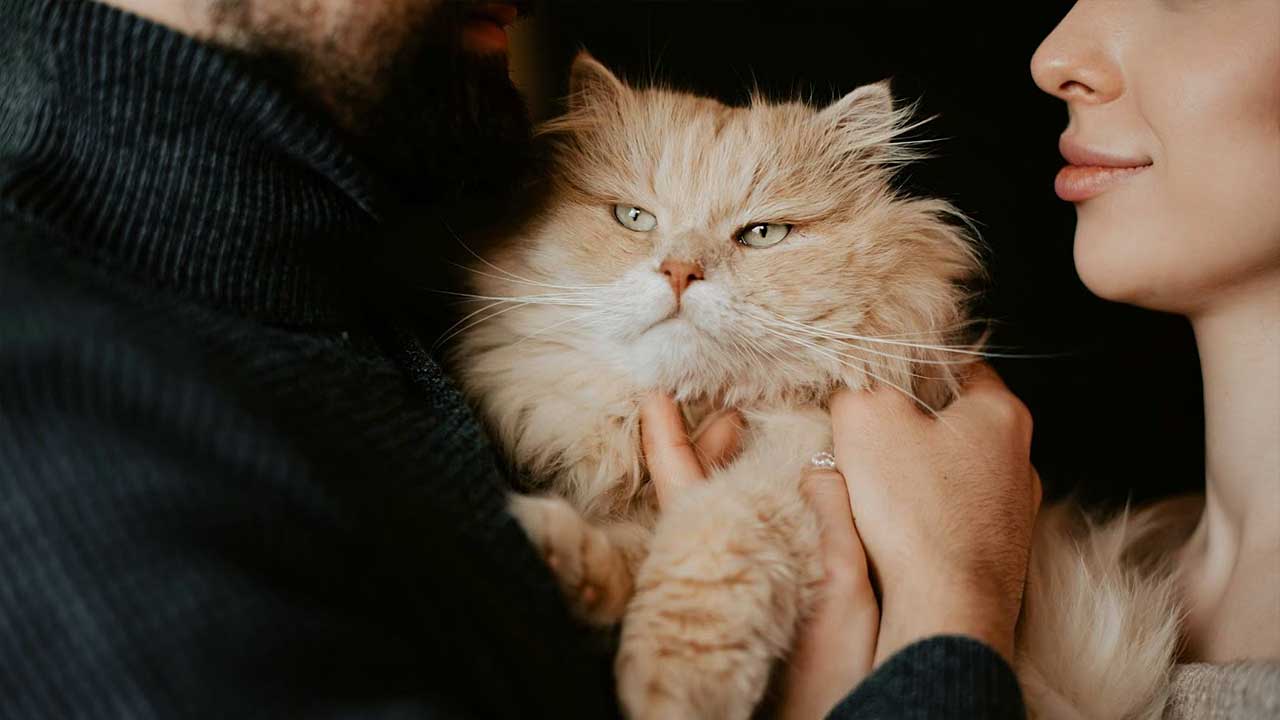
Photo caption: Writing an obituary is the “purrfect” way to gently share your loss with friends and family. Photo of a couple hugging Persian cat.
Why Writing an Obituary Helps with Grief 💞
Grief researchers often speak about continuing bonds — the idea that healing does not require forgetting. Instead, we find ways to carry the relationship forward.
Writing a tribute helps you:
- Organize memories before they fade
- Express gratitude for the life you shared
- Acknowledge the caregiving journey
- Preserve the story for the years ahead
For many families, the reflection that brings the greatest peace is a simple one:
We loved them well.
Frequently Asked Questions
How do I start writing a pet obituary? Begin with a simple list: "I remember…" Write down your first memories — the specific ones, the funny ones, the ones only your family knows. Those become the heart of your tribute.
Can I write a pet obituary before my pet dies? Yes — and many families find it deeply meaningful to do so. Writing during the hospice journey can help you process emotions in real time, celebrate your pet's life while they are still with you, and feel more prepared for the grief that follows.
Is it okay to share a pet obituary on social media? Absolutely. Sharing a tribute — even a short one — often invites unexpected support from friends, neighbors, and fellow animal lovers who may not have known how to reach out. You don't have to grieve alone.
Coming Soon: A Legacy-Building Guide 🧭
AHELP is developing a companion resource: How to Write a Legacy-Building Pet Obituary — a guided tool to help caregivers reflect on their pet's life as they navigate pet hospice and palliative care decisions.
A Quiet Reflection 🌈
In time, the obituary you write may become something more than a tribute.
It becomes a small record of a life that mattered — a collection of memories, stories, and photos that reflect the joy your companion brought into your world.
Years from now, those memories will still bring a smile.
And if you're anything like King's family, they might even make you laugh.
Join the AHELP Community 🐾
Members of the AHELP Community receive the monthly AHELPer Newsletter, including blog posts from AHELP and guest contributors, plus access to resources like the upcoming How to Write a Legacy-Building Pet Obituary.
AHELP supports families navigating:
- Pet hospice and palliative care
- Comfort care for aging and ailing dogs and cats
- In-home euthanasia decisions
- Pet quality of life assessment
- End-of-life planning and advance directives
- Bereavement support and healing after pet loss
Serving families in: 📍 Seattle, WA | 📍 Bellevue, WA | 📍 San Diego, CA — and beyond, through online support and in partnership with your own veterinarian.
🔜 Sign up to become a part of our AHELP Community and recieve our newsletter (scroll below).
Together, we can help more families walk their Path of Least Regrets to the Rainbow Bridge. 🐾💞👣🌈
( Blog post banner: Find old photos of your beloved companion animal in their younger years to include with their pet obituary. Here's a photo of a Border Terrier kissing dog mom on cheek. )
|
About the Author: Michelle NicholsAs an Animal Hospice Coach and Educator—a Pet Hospice Partner—I have the privilege of supporting families through one of life’s most sacred and challenging passages: accompanying a beloved dog or cat in their final chapter. My goal is to offer not only practical guidance but also emotional support and a deeper way to relate to this time—not just as an ending, but as a meaningful, even healing experience. With 30 years of combined experience in human and pet-related grief counseling, I continually refine my skills to serve pet parents best and to help prepare the next generation of pet hospice leaders through education and mentorship. My virtual door is always open. Reach me at [email protected]. |
Join Our Newsletter List!
You’ll receive the latest blog posts, useful tools, and plenty of inspiration. As a special gift, you'll receive a FREE Handout Combo download of Animal Quality of Life Indicators to Report to Your Veterinarian AND 40+ Questions to Ask Your Veterinary Team—both a valuable resource!

